As the effects of climate change unfold around us, Australian doctors, healthcare professionals and their communities are already facing its effects. In a recent paper, Dr Catherine Pendrey and colleagues emphasise the urgency of tackling climate change necessitates that medical professionals are rapidly upskilled to recognise and address climate-related health risks (1), and to ameliorate the environmental impact of their practice.
Medical school planetary health curriculum map
Since 2023, DEA’s medical education committee has been coordinating the Specialty-Based Planetary Health Curriculum Mapping Project in response to the success and momentum of the DEA Planetary Health – Organ System Map. Since its publication (2), the Planetary Health Organ System Map has informed medical curriculum changes across Australia, as observed by the work by Dr Sonia Chanchlani and colleagues (3) and internationally, as demonstrated by Wabnitz and colleagues study (4).
Specialty-based planetary health development map
This current project goes one step further to specialty-focused Planetary Health Curriculum Mapping, collaborating with educators, trainees and specialty colleges to integrate current evidence on healthcare sustainability and climate change into specialty medical and surgical education at all levels. The project responds to the need for high quality, evidence based materials to educate doctors on climate-health risks, and empower them to provide sustainable, low-carbon care. This is in alignment with recent changes to medical education regulatory standards (1) as climate health risk and sustainable healthcare are formalised as key assessment and accreditation components of medical training and practice.
Project design and progress
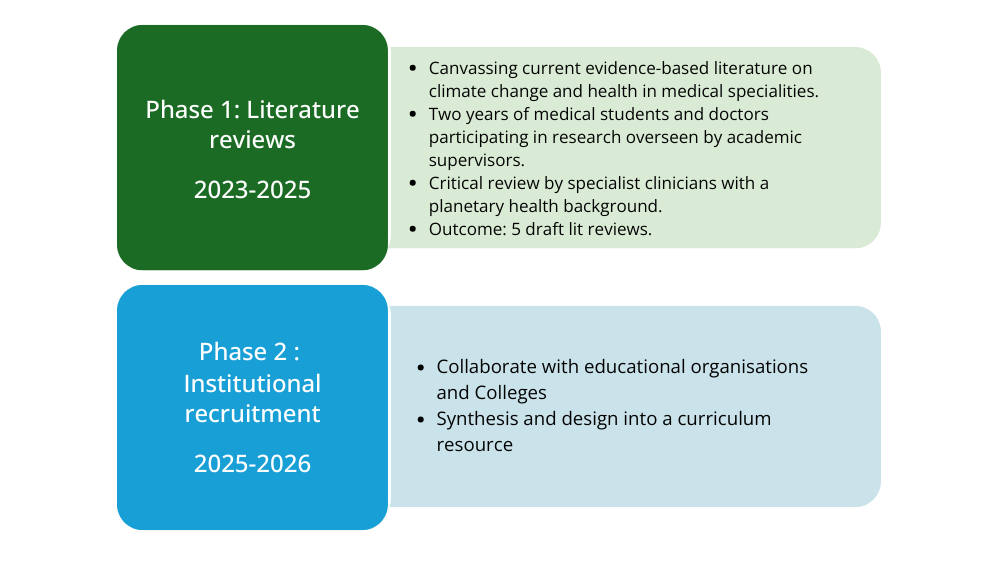
The project involves 2 phases: initially developing a series of specialty-specific literature reviews on climate change and health, followed by incorporating review findings into educational content and curriculum resources.
Phase 1 is currently underway. A team of dedicated medical students, doctors and academics have drafted 10-15 specialty based literature reviews that aim to summarise the relationships between climate change and health, including a focus on sustainable healthcare. The aim is for this evidence base to be used to inform relevant resources.
Next steps
Phase 2 involves collaborating with relevant education providers to transform the literature reviews into educational resources.
The Royal Australian and New Zealand College of Obstetricians and Gynaecologists (RANZCOG) will be using the phase 1 literature review to develop continued medical education (CME) for trainees and fellows, in addition to educational resources for clinicians and patients.
In April 2026, the Royal Australian and New Zealand College of Psychiatrists Planetary Health and Mental Health Advisory Group agreed to consider the content of the psychiatry review.
If your educational institution or specialty training college is interested in collaborating with DEA to finalise the phase 1 literature reviews and develop curriculum resources please contact [email protected].
References:
1. Pendrey CG, Chanchlani S, Beaton LJ, Madden DL. Planetary health: a new standard for medical education. Med J Aust. 2023 Dec 11;219(11):512–5. doi:10.5694/mja2.52158
2. Burch H, Beaton LJ, Simpson G, Watson B, Maxwell J, Winkel KD. A planetary health–organ system map to integrate climate change and health content into medical curricula. Med J Aust. 2022 Nov 7;217(9):469–73. doi:10.5694/mja2.51737
3. Chanchlani S, Mousley J, Robertson R, Polley C, Ticehurst L, Dunne B. Integrating Climate, Health, and Sustainability Principles into the Intern Education Curriculum. Poster presentation 2025.
4. Wabnitz K, Schwienhorst-Stich EM, Asbeck F, Fellmann CS, Gepp S, Leberl J, et al. National Planetary Health learning objectives for Germany: A steppingstone for medical education to promote transformative change. Front Public Health. 2022;10:1093720. doi: 10.3389/fpubh.2022.1093720